
July 21, 2026
Last week, the Centers for Medicare & Medicaid Services (CMS) released the Calendar Year (CY) 2027 Medicare Physician Fee Schedule proposed rule (CMS-1848-P).
CMS proposes to equalize payment for POS 31 and POS 32
Last year's rule created a practice expense (PE) payment differential for nursing facility visits based solely on whether a resident's stay was covered under a Part A facility-based stay, even though the clinician's work and costs are the same either way.
CMS now acknowledges this was unintended. In the CY27 proposed rule, CMS states, “we believe it is more accurate for these E/M services to be paid the same amount without regard to the beneficiary’s Part A status. Therefore, we are proposing to address this anomaly for CY 2027 by equalizing the rate for nursing facility visits without regard to the beneficiary’s status by setting the facility PE RVU equal to the non-facility PE RVU for CPT codes 99304 through 99310, 99315, and 99316.”
PALTmed’s advocacy has been focused on pushing for this fix over the past year. This is a proposal, not a final policy. It is subject to change before the final rule is issued. PALTmed will support this proposal and urge CMS to finalize it.
Conversion factor decreases
The temporary 2.5 percent update that applied in CY 2026 expires at the end of the year. For CY 2027, CMS proposes a conversion factor (CF) of $32.8409 for clinicians who are not qualifying APM participants, a decrease of 1.68 percent. Clinicians who are qualifying APM participants would see $33.1693, a decrease of 1.19 percent.
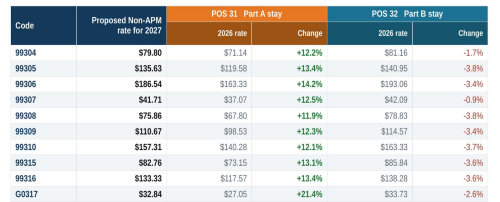
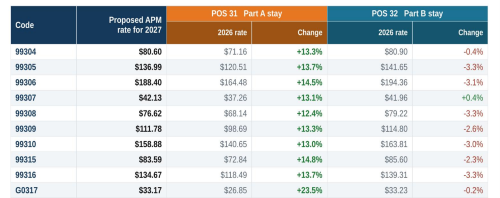
The tables below show estimated rates using the proposed rule's conversion factors and the proposed 2027 RVUs, which are lower for most of these codes. The practice expense fix pulls POS 31 up while the other codes drift down.
- Under the proposal, POS 31 and POS 32 are paid the same rate in 2027. Because that single rate sits above the old POS 31 (facility) rate but below the old POS 32 (non-facility) rate, a Part A stay visit gains 12 to 14 percent while a Part B stay visit slips between 0.9 and 3.8 percent.
- Qualifying APM participants follow the same pattern at slightly higher rates: POS 31 up 12 to 15 percent, POS 32 between plus 0.4 and minus 3.3 percent.
The conversion factor accounts for about 1.68 percent of the year-over-year decrease. The rest comes from lower RVUs.
Nursing Home Codes (Non-APM CF= 32.8409)
Nursing Home Codes (APM CF= 33.1693)
G2211 is changing, and nursing facilities remain excluded
CMS proposes to eliminate HCPCS code G2211, used to capture the extra time and cognitive complexity of providing ongoing, longitudinal medical care, and replace it with a modifier worth 16 percent of the base E/M code. A second modifier worth 32 percent would be available only to clinicians participating in a Shared Savings Program ACO or the new LEAD Model.
Both modifiers would apply to office, outpatient, home, and residence visits. Nursing facility visits remain excluded.
Advance care planning would be recoded
CMS proposes two new codes covering advance care planning delivered by clinical staff under a clinician's supervision and would restrict CPT codes 99497 and 99498 to time the billing a clinician personally spends. Both new codes would be added to the Medicare telehealth list.
The proposed new codes would be G-Code GACP1 and GACP2. These new G-codes and CPT codes 99497-99498 could be reported together if time thresholds by the billing practitioner and clinical staff were each met with these respective code sets.
CMS is specifically asking for input on how advance care planning is actually delivered, including the care team structure, how time is divided between clinicians and staff, and the settings where these conversations happen.
Telehealth remains largely stable
The geographic and originating site flexibilities have been extended through December 31, 2027, by the Consolidated Appropriations Act, 2026. Audio-only telehealth and the delay of the mental health in-person requirement are extended to January 1, 2028. Clinicians should be aware of two new modifiers, BB and BC, that take effect January 1, 2027, for certain telehealth services. These modifiers do not affect payment and are required for claims for telehealth services that are furnished through a virtual telehealth platform by a physician or practitioner that contracts with an entity that owns such virtual platform; or for which a physician or practitioner has a payment arrangement with an entity for use of such virtual platform; and for claims for telehealth services that are furnished incident to a physician's or practitioner's professional service.
The permanent removal of frequency limits on subsequent nursing facility visits furnished via telehealth, which PALTmed supported, was finalized last year and remains in place.
Remote monitoring rules would tighten
CMS proposes significant new restrictions on remote physiologic monitoring (RPM) and remote therapeutic monitoring (RTM), citing two HHS Office of Inspector General reports on how these services have been billed.
Three changes matter most for clinicians using these services. First, RTM would be limited to established patients, matching the rule that already applies to RPM. Second, both RPM and RTM would require a face-to-face visit, in person or via telehealth, to initiate the service, and monitoring would need to be discussed at that visit. Third, payment would be allowed only when the clinical staff furnishing the service are direct employees of the practice. As of January 1, 2027, services contracted out to third-party monitoring companies would no longer be billable.
MIPS
CMS proposes to sunset traditional Merit-based Incentive Payment System (MIPS) reporting beginning with the 2029 performance year, leaving MIPS Value Pathways and the APM Performance Pathway as the remaining options. CMS also proposes three new MVPs, including one for hospitalists. MVPs are one way (an alternative to traditional MIPS and APM Performance Pathway (APP)) for clinicians to meet MIPS reporting requirements. Each MVP includes a subset of measures and activities related to a given specialty or medical condition.
Shared Savings Program
CMS proposes to add the new advance care planning codes (GACP1 and GACP2) to the list of primary care services used to assign beneficiaries to ACOs. And in a request for information on strengthening specialty care in ACOs, CMS specifically flags the risk of fragmentation for high-need beneficiaries and those receiving long-term care. The broader package includes higher shared savings for ACOs in the BASIC track and new incentives for first-time participants.
PALTmed staff is still reviewing the rule in full and identifying the provisions where our comments will carry the most weight. PALTmed will submit formal comments before the September 14 deadline.