

November 5, 2026
The 2025-2030 Dietary Guidelines: Have Health Professionals Changed Their Nutrition Recommendations for Older Adults?
By Phyllis Famularo, DCN, RD, LDN, FAND
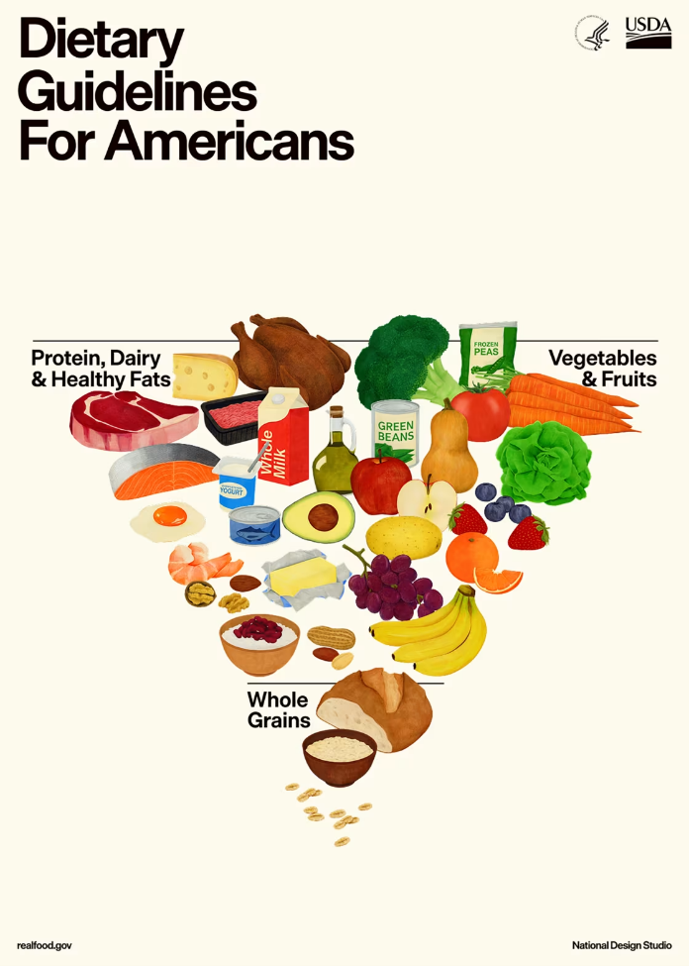
Since the release of the 2025-2030 Dietary Guidelines for Americans (DGA) on January 7, 2026, there has been both agreement and dissent.1 While there are some recommendations that were guiding principles in prior dietary guidelines, there are some new or altered recommendations that health professionals oppose and some that are causing confusion for consumers.
What areas of the revised Dietary Guidelines are in agreement with prior recommendations?
Let’s first discuss the agreed-upon aspects of the revised guidelines:
- Consume vegetables and fruits throughout the day with the goal of 5 or more servings. While fruit and vegetable intake is highest among adults aged 51 and older, only 12.5% of this age group currently consume the recommended 5 servings or more per day.2
- Eat the right amount of food for you. Obesity continues to be a great concern for Americans. In older adults, obesity has risen significantly over the past several decades and has nearly doubled in adults 65 and over, increasing from 22% to 40% between 1988–1994 and 2015–2018.3 While calorie management remains a goal, unfortunately, many Americans are not meeting it. With the rapid increase in prescription of glucagon-like-peptide (GLP-1) agonists since 2024, national obesity rates have decreased in adults except those 65 years of age and older.4
- Incorporate healthy fats. While the healthy fats in eggs, omega-3–rich seafood, nuts, seeds, olives, and avocados continue to be in the new guidelines, fats in poultry, meats (including red meats), and full-fat dairy are also noted as healthy fats. Consuming red meats and full-fat dairy is one of the controversial areas reviewed later under the challenging areas of the new guidelines.
- Focus on whole grains. This is another area that conforms with the previous recommendations. Americans continue to consume only about 15–16 grams of fiber per day, which is significantly below the recommended 25–38 grams for adults. Numerous studies exist touting the benefits of whole grains in preventing and managing chronic diseases, including cardiovascular disease, diabetes, and cancer, among others.5
- Limit highly processed foods (HPF), added sugars, and refined carbohydrates. The guidelines recommend avoiding “highly processed packaged, prepared, ready-to-eat, or other foods that are salty or sweet, such as chips, cookies, and candy that have added sugars and sodium.” Sweetened beverages are also included in this recommendation. In the United States, over 50% of energy intake in older adults are HPF, which has risen steadily over the past decade.6
- Sodium intake. The new guidelines recommend limiting sodium intake to 2300 mg/day; however, they do not emphasize reducing sodium intake, but rather indicate that “sodium and electrolytes are essential for hydration,” which might promote the intake of hydration beverages that contain sodium.
- Lastly, the recommendation to limit alcoholic beverages continues to be included. Older adults should be aware of any medications that are contraindicated with alcohol. The risk of addiction is still a concern even in older adults who previously did not consume alcohol. Alcohol tolerance is lower in older adults due to lower muscle mass and total body water.7 Alcohol consumption also increases the risk of developing dementia.8
What areas of the revised Dietary Guidelines are being challenged?
The following are areas that are disputed by dietitians, medical practitioners, and certain associations such as the American Heart Association (AHA).
Let’s return to healthy fats. The revised guidelines continue to stress that saturated fat intake should not make up more that 10% of daily calories. This target has been generally difficult to meet in individuals who consume meat because all animal products contain saturated fats. Past recommendations have focused on allowing 1-2 smaller portions of meat daily, while the remainder of fat should come from low-fat and healthy fats such as olive oil, nuts, avocados, etc. The new guidelines recommend full-fat dairy and include red meats, and even beef tallow, which would make it very difficult to adhere to the 10% saturated fat guideline.
This recommendation was based on a number of recent studies that have reported that full-fat dairy products may not impact cardiovascular health.9 One study reported that after 12 weeks, adults who consumed three servings/day of full-fat items daily exhibited no significant increases in weight, body fat, cholesterol, or insulin resistance.10 This research only included 74 subjects.
If we are now recommending more meat and full-fat dairy, saturated fat intake likely will be much greater than 10%, and increasing to 20-25% of daily calories. Current guidelines recommend only 20-30 grams of saturated fat per day; one glass of whole milk contains 10 grams. So, the conundrum is how do we consume adequate calcium intake while limiting saturated fat intake if we are consuming full-fat dairy? The American Heart Association’s 2026 dietary guidelines continue to recommend replacing saturated fat with unsaturated fat.11
- A second area that is widely debated is the new recommendation for protein intake of 1.2 to 1.6 grams of protein per kilogram of body weight/day, and to prioritize protein at every meal. Increased daily protein has been recommended for older adults to prevent sarcopenia, however, up to 1.6 g/kg may be excessive in light of impaired kidney function in many older adults.12 Data on kidney function in older adults notes that (1) About 34% of older adults over 65 have chronic kidney disease (CKD); about 47% of adults over age 70 have CKD, and experts estimate that over half of adults over 75% have CKD.13 (2) Once CKD reaches stage 3 (estimated glomerular filtration rate of 30 – 59 mL/min), protein recommendations drop to 0.6-0.8 g/kg, so there are many older adults who should not consume excess protein in order to preserve kidney function. It is unclear whether a high protein diet is a causative factor in the development of CKD, but greater caution should be encouraged when recommending higher protein intakes in older adults as CKD incidence increases in individuals with diabetes, hypertension, and cardiovascular disease.
- The new guidelines recommend avoiding added sugars but also non-nutritive sweeteners. Evidence indicates that non-nutritive sweeteners can be safely used in moderation and may help with controlling carbohydrate intake in glucose-intolerant individuals.14
- The final item that has been disputed by dietitians and other health professionals is the new upside-down pyramid depicting the 2025-2030 guidelines. While it recognizes the importance of fruits and vegetables, the pyramid minimizes the benefits of whole grains. Additionally, there are large portions of poultry and even red meats right at the top, which indicates not only the consumption of more protein but also more saturated fat.
What dietary guidelines are recommended for older adults by registered dietitians?
While the new 2025-2030 DGA have promoted some controversy, there are some basic recommendations that are good for all Americans, including older adults, to both prevent and manage chronic diseases, many of which are common in older adults:
- Consume as many fruits and vegetables as possible every day. Try to have one or two servings with every meal or as a snack. You can even have a salad for breakfast!
- Make your grains whole grains, including breads and cereals, but also pastas and brown rice. Try some other whole grains like quinoa and barley. Protein and fiber in legumes are great ideas, too!
- Try to consume at least three calcium-rich food sources per day. If limiting calories, low-fat dairy is appropriate. Calcium from food is absorbed better than calcium supplements. If lactose-intolerant, choose alternate non-dairy milks that are fortified with calcium, such as oat or soy milk (300 to 450 mg calcium/cup).
- Avoid adding salt at the table; use minimal salt in cooking. Limit the intake of high-sodium meats and processed foods. Taste buds adjust to lower sodium intake, and a person will “learn” to enjoy the taste of the food they are eating. Consider the use of low-salt alternatives such as a 50/50 mixture of potassium and sodium chloride, but only in adults who do not have CKD.
- Choose healthy fats such as olive oil, omega-3 fatty acids in seafood, avocados, etc. Limit intakes of meats to 1-2 small servings per day and other processed foods containing saturated fat. Only consume extra protein if advised by a physician or dietitian, as they will know your kidney function.
- Remember, calories in should equal calories out. Be aware of your weight and pair healthy eating with daily movement.
Find the references for this article here.
Ms. Famularo is a registered dietitian with Sodexo Seniors and has worked with older adults for over 35 years. She has a doctorate in clinical nutrition from Rutgers University and is a fellow of the Academy of Nutrition and Dietetics.