

May 4, 2026
Age-Friendly Heart Failure Care in the Nursing Home: Applying the 4Ms Framework to Guide Clinical Decision-Making
By Nestor Flores Buonomo, MD
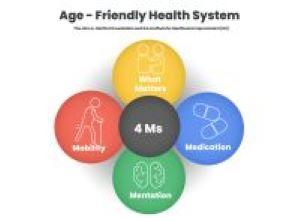
In a previous article, I described my journey discovering the complexities of heart failure management in nursing home residents. This is a population where guideline-directed medical therapy (GDMT) often collides with the realities of frailty, falls, cognitive impairment, and competing goals of care. Through a quality improvement project at the Long Island State Veterans Home at Stony Brook, I found that among 78 residents with confirmed heart failure, not a single one was on all four pillars of GDMT. More striking, over half met at least one high-risk criterion that made aggressive medical therapy potentially dangerous.
This raised a fundamental question: How do we provide evidence-based heart failure care to frail elderly nursing home residents while honoring their individual goals and minimizing harm? The answer lies in reframing our approach through the 4Ms of Age-Friendly Health Systems: What Matters, Medications, Mentation, and Mobility. This framework, developed by the Institute for Healthcare Improvement and The John A. Hartford Foundation, offers nursing home clinicians a structured yet flexible approach to optimizing heart failure care in our most vulnerable patients.
What Matters: The Foundation of Every Treatment Decision
Heart failure management in the nursing home must begin with a fundamental question: What does this resident want from their care? The 4Ms framework places "What Matters" at the center because it should guide every subsequent decision about medications, cognitive considerations, and mobility interventions.
In our QI project, we found that goals-of-care conversations were often absent or incomplete. Three of our 78 residents with heart failure were already in hospice, yet they remained on medications with time-to-benefit horizons that extended well beyond their prognosis. For nursing home residents, clinicians should routinely ask: "What matters most to you, living as long as possible, maintaining independence, or prioritizing comfort?" The answers will vary dramatically.
An 85-year-old veteran with heart failure with reduced ejection fraction (HfrEF) who remains cognitively intact and wants to attend his granddaughter's wedding in six months has different goals than a 92-year-old woman with advanced dementia whose family prioritizes comfort. Both deserve heart failure care, but the intensity, medication burden, and monitoring parameters should reflect their individual priorities. Document these conversations and revisit them regularly, particularly after hospitalizations or evidence of functional decline.
Medications: Balancing GDMT with Age-Friendly Prescribing
The four pillars of GDMT for HFrEF—RAAS inhibitors (ACE inhibitors, ARBs, or ARNIs), beta-blockers, mineralocorticoid receptor antagonists (MRAs), and SGLT2 inhibitors—have proven mortality benefits. However, our QI data revealed that only 27 of 78 residents were on beta-blockers, 17 on RAAS inhibitors, 14 on MRAs, and 14 on SGLT2 inhibitors. Why was there such low utilization?
The answer lies in the high-risk profile of our population. Twenty-five residents had fallen within the past year. Each additional medication increases fall risk by 7-10%. Nine had eGFR below 35 mL/min, limiting ACE inhibitor and MRA options. Nine had documented orthostatic hypotension, and four had prior hyperkalemia. These are not contraindications to treatment; they are invitations to practice Age-Friendly prescribing.
Age-friendly medication management in heart failure means:
- Start low, go slow: Titrate medications gradually with close monitoring of blood pressure, renal function, and potassium. These should ideally be monitored 5-7 days after initiation.
- Prioritize symptom control: Diuretics remain essential for volume management, but monitor closely for orthostatic hypotension and electrolyte disturbances.
- Consider time-to-benefit: Beta-blockers and RAAS inhibitors require 3-6 months to show mortality benefits. For residents with limited life expectancy, symptom management may take precedence.
- Embrace deprescribing: Review all other medications. Benzodiazepines, anticholinergics, and sedative-hypnotics compound fall risk and cognitive impairment.
- Leverage SGLT2 inhibitors thoughtfully: These agents show benefits across the heart failure spectrum and may have favorable side-effect profiles compared to older agents, but evaluate renal function first and monitor for volume depletion and genital mycotic infections.
Involve your clinical pharmacist, nursing staff, and physical therapist in regular medication reviews. Multidisciplinary collaboration in nursing home care is a strength.
Mentation: Addressing the Cognitive-Cardiac Connection
Dementia, delirium, and depression are inextricably linked to heart failure outcomes in nursing home residents. Cognitive impairment affects a substantial proportion of our population, and it fundamentally changes how we approach heart failure management.
Residents with dementia cannot reliably report symptoms of dyspnea, fatigue, or dizziness. They may not recognize worsening edema or comply with fluid restrictions. Some cannot participate meaningfully in goals-of-care conversations without surrogate involvement. Our assessment of heart failure in these patients must rely more heavily on objective measures: daily weights, vital signs, pulse oximetry, urine sodium, and careful physical examination.
Delirium deserves special attention. Any change in mental status in a heart failure patient should prompt evaluation for both cardiac decompensation and medication-related causes. Beta-blockers can cause fatigue and cognitive slowing; diuretic-induced electrolyte disturbances can precipitate confusion; and overdiuresis leading to hypotension may manifest as altered mentation before other signs appear.
Depression, often underrecognized in nursing home residents, worsens heart failure outcomes and quality of life. Screen for depression routinely and address it—sometimes with medication, often with non-pharmacological interventions like increased social engagement and therapeutic activities.
Age-friendly mentation care in heart failure includes:
- Ensuring residents have access to glasses, hearing aids, and dentures to maximize cognitive function.
- Orienting residents to time, place, and situation each nursing shift.
- Minimizing sleep interruptions and avoiding high-risk medications that worsen cognition.
- Engaging family members and caregivers to identify subtle changes in baseline mental status.
Mobility: Moving Toward Function, Not Just Survival
Heart failure and functional decline create a vicious cycle. Dyspnea and fatigue limit activity; deconditioning worsens exercise tolerance; and progressive frailty increases fall risk and mortality. The 4Ms framework reminds us that our goal is not merely to prolong life but to help residents maintain function and do what matters to them.
Twenty-five of our 78 heart failure residents had fallen in the past year. Falls in this population can reflect the intersection of cardiac medications, orthostatic hypotension, muscle weakness, and environmental factors. Every fall increases the risk of hip fracture, subdural hematoma, and a cascade of further decline.
Age-friendly mobility care means:
- Conducting fall risk assessments using validated tools like the Timed Up & Go test.
- Engaging physical therapy early and often; beyond rehabilitation after an event, but for strength training, balance exercises, and gait optimization.
- Encouraging mobilization: Aim for ambulation three times daily and out of bed for meals when possible. Aim for specific daily step goals if possible.
- Reviewing medications that increase fall risk: Diuretics, beta-blockers, sedatives, and opioids all contribute. Can doses be reduced? Can timing be optimized?
- Removing tethers: Foley catheters, IV lines, and telemetry leads keep residents bed-bound. Remove them when no longer essential.
Set realistic, individualized mobility goals. For some residents, the goal is walking to the dining room; for others, it may be transferring safely from bed to chair. Both are meaningful.
Putting the 4Ms Together: A Framework for Clinical Practice
The power of the 4Ms lies in their integration. When assessing a nursing home resident with heart failure, ask:
- What Matters: What are this resident's goals? What would they want if their heart failure worsens? Who speaks for them if they cannot speak for themselves?
- Medications: Are they on appropriate GDMT given their goals, life expectancy, and risk profile? Are there medications that should be deprescribed? Is polypharmacy contributing to a prescribing cascade, falls, or cognitive decline?
- Mentation: How is their cognition? Are they showing signs of delirium or depression? Can they participate in their own care, or do we need enhanced staff monitoring?
- Mobility: What is their functional status? Are they at high risk for falls? What interventions can preserve or improve their mobility?
These four domains interact. A medication adjustment affects mobility through orthostatic hypotension. A fall affects mentation through fear of future falls and potential head injury. Cognitive decline affects what matters because it changes who makes decisions. By viewing heart failure through the 4Ms lens, we move beyond isolated medication titration toward a more holistic care approach.
Conclusion: From Guidelines to Individualization
Heart failure guidelines were developed for community-dwelling adults in clinical trials that largely excluded nursing home residents. Applying these guidelines without adaptation does our residents a disservice. The 4Ms framework provides a structure for individualizing care while remaining grounded in evidence.
As I continue my work in nursing home medicine, the 4Ms have become my clinical compass. They remind me that every resident is more than a diagnosis, every medication decision has ripple effects, and every treatment plan should honor not just the disease but the person living with it. This is what Age-Friendly heart failure care looks like in the nursing home: thoughtful, individualized, and centered on what matters most.
Dr. Nestor Flores Buonomo is a geriatric medicine fellow at Stony Brook University Hospital.