

May 4, 2026
Updated Perspective: CGM in Residents of Nursing Homes
By Naushira Pandya, MD, CMD, FACP, FPLTC, and Barbara Zarowitz, PharmD, MSW, FPLTC
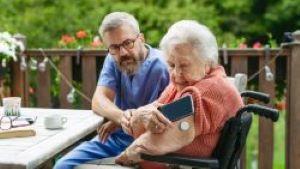
The evaluation of glycemic control in most long-term care facilities is conducted by fingerstick blood glucose monitoring and periodic A1C measurements. However, studies show that patients with diabetes in these settings are overtreated and have significant hypoglycemia even when c values are >8%.1 Moreover, a normal A1c of 7%, for example, may be seen in patients with significant hyperglycemia and hypoglycemia, i.e., wide glucose excursions that in and of themselves are associated with increased complications.
Recent findings of a cohort study in nursing home residents with diabetes confirm that fingerstick blood glucose monitoring has high specificity but poor sensitivity in detecting hypoglycemia and fails to detect approximately four in five hypoglycemic events.2 Under-detection of hypoglycemia was consistent between residents, across days, and within 8-hour interval analyses. Continuous glucose monitoring (CGM) can detect nocturnal hypoglycemia and can be used to document fasting glucose values early in the morning without necessitating additional fingersticks.
The 2026 American Diabetes Association (ADA) standards of care in older adults and diabetes technology standards recommend consideration of CGM for nursing home residents with type 1 and type 2 diabetes on insulin therapy to reduce hypoglycemia, improve glycemic outcomes, and reduce treatment burden.3,4
Residents of nursing homes have multiple complexities requiring careful, individualized assessment of mobility, mentation, and medications with management preferences established in the context of what matters to them – the 4Ms. The 2026 ADA standards recommend applying the age-friendly framework to address person-specific issues that can affect diabetes management.3 Through this approach, individualized selection of glucose- lowering medications, delivery devices, and monitoring technology can occur.
CGM has been shown to improve glycemic control in patients with type 1 diabetes or insulin-requiring type 2 diabetes in people of all ages, including older adults. Benefits have accrued in older individuals with diabetes who do not receive insulin therapy for reducing hypoglycemia and improving other glycemic outcomes.
Reasonable CGM goals for older adults with complex/intermediate care needs are 70 – 180 mg/dL with time in range of greater than or equal to 50% and time below range < 70 mg/dL of less than 1%.3 For these same individuals, A1c goals of less than 8% are reasonable. It should be remembered that certain medications/substances interfere with CGM devices. Of particular relevance for people residing in nursing homes is the interference acetaminophen > 4 grams/day has with Dexcom G6 and Dexcom G7 and acetaminophen at any dose with Medtronic and Guardian 4. In both cases, acetaminophen produces higher sensor readings than actual serum glucose.4 While used less commonly in PALTC settings, ascorbic acid, hydroxyurea, mannitol, and sorbitol also produce higher sensor readings than actual serum glucose.
Contact dermatitis (both irritant and allergic) has been reported with all devices that attach to the skin, and in allergic cases may be linked to isobornyl acrylate. Skin reactions should be assessed, and allergens eliminated, to ensure comfortable use of CGM patches. Patch testing can sometimes identify the allergen.
When prescribing a CGM device, ensure that people with diabetes, and their caregivers, including facility staff, as well as practitioners, are offered initial and ongoing training and education to optimize use of the device and to adjust treatment based on interpretation of the ambulatory glucose profile and glucose trends.
Other benefits of the use of CGM in PALTC settings are decreasing patient discomfort with frequent and often unnecessary fingerstick monitoring, freeing up nursing time, glucose monitoring of residents with diabetes requiring room isolation, and those at the end-of-life whose blood glucose levels may have significant fluctuations. While further research in diverse racial and cultural groups residing in nursing homes is indicated, integrating CGM in PALTC can provide a more comprehensive and accurate picture of a resident’s diabetes status.
Naushira Pandya is a board-certified geriatrician and endocrinologist who is the professor and chair of the Geriatrics Department at the Nova Southeastern University's Kiran C. Patel College of Osteopathic Medicine. She has chaired the Diabetes Management in Post-Acute and Long-Term Care Settings guideline, and her main clinical and research interests are the care of older adults living with diabetes.
Barbara J. Zarowitz is editor-in-chief of Caring for the Ages. Since March 2017, she has been the owner and sole proprietor of Barbara J Zarowitz, LLC – Advancing Geriatric Pharmacotherapy Solutions. She has also held a variety of leadership and academic positions including with CVS Health, Omnicare, Inc., Wayne State University's College of Pharmacy and Health Sciences, and the University of Maryland.
References
1. Bouillet, B., Tscherter, P., Vaillard, L., Nonciaux, C., Hourdain, P., Ravier, A., ... & Quilot, E. Frequent and severe hypoglycaemia detected with continuous glucose monitoring in older institutionalised patients with diabetes. Age and Aging, 2021;50(6): 2088-2093.
2. Khan MA, Munshi MN, Slyne C, Joyce NR, Zullo AR. Agreement between fingerstick blood glucose and continuous glucose monitor measures among long-term care facility residents. J Am Geriatr Soc 2025;73:3369-3375. doi: 10.1111/jgs.70024
3. American Diabetes Association Professional Practice Committee for Diabetes. Older adults: standards of care in diabetes – 2026. J Am Geriatr Soc 2026;49 (Suppl. 1):S277-S296. doi: 10.2337/dc26-S013
4. American Diabetes Association Professional Practice Committee for Diabetes. Diabetes technology: standards of care in diabetes – 2026. J Am Geriatr Soc 2026;49 (Suppl. 1):S150-S165. doi: 10.2337/dc26-S007