
September 8, 2026
Addressing Nursing Home Residents’ Unmet Needs with Animal-Assisted Therapy
By Howard J. Finger, DO, and Deepa Vinoo, RN, DNP
Unmet Needs
Individuals living with dementia, who find themselves in unfamiliar PALTC settings, often exhibit problematic behaviors, such as physical aggression or verbal agitation, to seek attention. These behavioral and psychological symptoms of dementia (BPSD) are key clinical features of Alzheimer’s disease and related dementias (ADRD). They often serve as a primary form of communication for those with ADRD who cannot communicate what they seek, but instead express their unmet needs as BPSD. In PALTC settings, understanding that BPSD can be attempts by persons living with ADRD to communicate unmet needs is essential to facilitate clinical care decisions and improve quality of life.1
Unmet needs may relate to factors such as pain, loneliness, dehydration, sleep deprivation, incontinence, undiagnosed infections, lack of meaningful social contact, environmental discomfort, or insufficient sensory stimulation. Such needs often go unrecognized due to their communication impairments and cognitive limitations, along with their limited ability to navigate their environment effectively.
Finding and addressing these unmet needs through person-centered care can significantly reduce BPSD, improving these residents’ quality of life and easing the strain on caregivers. Identifying and addressing unmet needs are key to effective care planning, including the use of non-pharmacological interventions. Sometimes what they seek is simple and accessible, such as the company of a pet dog; however, it is incumbent upon care teams to diligently search for these unmet needs.
Animal-Assisted Therapy in Older Adults
Animal-assisted therapy, which uses trained animals such as dogs and cats, can help address the physical and emotional needs of older adults in PALTC settings. A literature review of the health benefits associated with its use in older adults in hospitals and long-term care facilities bears this out, finding that it can improve sleep, reduce depression, and enhance mood.2 This stands to reason, as many residents in PALTC settings either once owned pets, or shared a deep bond with pets during stages in their lives. For many, interacting with pets was part of their daily routines, which was taken away from them due to illness, creating a void in their lives that needs to be filled.
For them, animal-assisted therapy may be the solution to filling this unmet need. For PALTC facilities, which do not offer animal-assisted therapy programs due to a lack of expertise and cost concerns, consider procuring the services of a reputable therapy animal organization with trained, screened therapy animal teams that undergo background checks, adhere to infection control protocols, and perform regular re-evaluations to ensure suitability for residents.
The Story of Momo
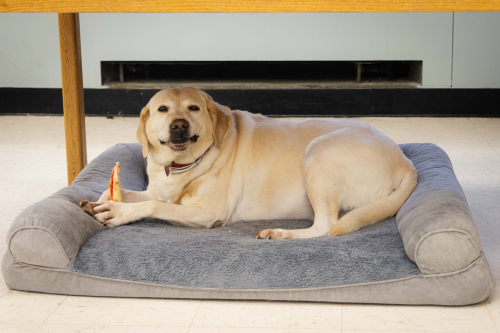
Momo, a yellow Labrador Retriever, was the first in-residence therapy dog at Coler Rehabilitation and Nursing Care Center in New York City when she was donated in January 2020, two months prior to the onset of the COVID-19 Pandemic. Right from the start, Momo’s gentleness and pleasant demeanor provided comfort and relief for Coler’s resident population, as she visited them in the unit dayrooms, at their bedside, and at the facility's special events. During the pandemic months, she was like a ray of sunshine and hope to both residents and staff, possessing an intrinsic calming effect, which helped reduce their stress and anxiety. Over time, Momo became an integral part of the fabric of life at Coler, as staff and residents would pause and wave at Momo with broad smiles.
She had an uncanny ability to make residents feel better, especially one resident receiving in-house hemodialysis. He found the sessions grueling, often struggling to complete them, but Momo’s presence re-energized him each time, bringing a fresh smile to his face. The two shared a special bond, as did many others with Momo. Sadly, Momo succumbed to renal failure on April 15, 2025. Within months of her passing, in an ironic twist of fate, that same resident, whom Momo comforted so magnificently, also succumbed to his illness.
“Man’s Best Friend”
The phrase “man’s best friend” refers to domestic dogs, connoting their loyalty, friendship, and companionship with humans. For many, the phrase rings true, reflecting how we feel about our cherished canine companions. For the staff and residents at Coler, I am certain that the same sentiment was shared for Momo.
The following poem (see below), which I wrote, “Man’s Best Friend,” describes the important role that pet dogs play in shaping and enriching our lives. It details how both the seasons of the year and the seasons of our lives are indelibly entwined with memories of these cherished pet dogs. From our earliest memories to the present, as we confront tomorrow’s uncertainties, our cherished canine companions help comfort us, even in the winter of our lives, in keeping with the true meaning of the phrase “man’s best friend.”
Man’s Best Friend©
By Howard J. Finger
When spring arrives, we’ll be cheering.
No more blizzards, we’ll be fearing.
Bluebirds singing, we’ll be hearing.
The snow will be disappearing.
Yet, while we’re in winter’s last hold,
we’ll be shivering in her cold,
waiting for spring to scurry by
like a puppy dog, young and spry.
All sorts of tricks, we’ll teach him well—
to fetch a ball and ring a bell,
to be playful and not act shy
and look folks squarely in the eye.
We’ll coddle him and we’ll nurture
as we watch him grow and mature.
But to us, he will always be
spry and playful as a puppy.
When summer comes, we’ll be cheering.
No more late frost, we’ll be fearing.
More birds singing, we’ll be hearing.
The tree pollen will be clearing.
Yet, while we’re in spring’s last embrace,
we’ll slow dance—not cut to the chase,
and we’ll reflect for a long while.
Then Spring, we’ll beg for one last smile.
Like a Great Dane, summer shall be—
swift and sleek, but not so cuddly
and less playful than a puppy,
always as busy as a bee.
Like a Great Dane, summer shall race.
We will do our best to keep pace.
When August dies, we will lament—
clinging to youth, but not hell-bent.
When fall comes, we’ll not be cheering.
No summer love, we’ll be fearing.
Less birds singing, we’ll be hearing.
Autumn leaves will be appearing.
Yet, while we’re in summer’s last hold,
we’ll feel her warmth, and we’ll act bold.
We’ll try to resist growing old.
We’ll not look forward to the cold.
Then fall will slowly creep on by
like a hound dog, clever and sly—
always near to us, never far.
We will let him ride in our car.
And he’ll have a sixth sense for sure.
What ails us, he’ll know, there’s no cure.
But he’ll make us forget our woes,
by the fireplace while we doze.
When winter comes, who’ll be cheering?
Everything, Lord, we’ll be fearing.
No birds singing, we’ll be hearing.
The harshest days will be nearing.
Yet, while we’re in fall’s last embrace,
we’ll try to put on a brave face.
And we’ll poke fun as we grow old.
We’ll act nonchalant in the cold.
Like a husky, winter shall be,
pulling our sled for all to see.
And she’ll have a mind of her own,
but we will still throw her a bone.
The other dogs, we’ll remember
in the harsh and bleak December.
Loyal, they’ll remain to the end.
Each will always be man’s best friend.
References
1. Warren A. (2022). Behavioral and psychological symptoms of dementia as a means of communication: Considerations for reducing stigma and promoting person-centered care. Frontiers in psychology, 2022;13: 875246. https://doi.org/10.3389/fpsyg.2022.875246
2. Veilleux A. Benefits and challenges of animal-assisted therapy in older adults: a literature review. Nursing Standard, 2020;36(1):28–33. doi:10.7748/ns.2020.e11625
Howard J. Finger is attending physician/clinical ethics consultant at Coler Rehabilitation & Nursing Care Center and at Henry J. Carter Specialty Hospital & Nursing Facility in New York City. Dr. Finger was named the 2025 Clinician of the Year by the Foundation for PALTC Medicine.
Deepa Vinoo, DNP, RN, Gero-BC, CDP, is the director of memory care at NYC Health + Hospitals/Coler, which earned the AACN Beacon Award for Excellence in 2024 for its memory care units. On December 7, 2026, at a conferring ceremony, the Royal College of Surgeons in Ireland will award her a Fellow by Examination of the Faculty of Nursing and Midwifery (FFNMRCSI).